


The Moving Castle of Data
A Fictitious Analogy Story About AI Readiness, Data Cleansing, and the Cost of Comfortable Stagnation
Inspired by Hayao Miyazaki's Howl's Moving Castle (2004), produced by Studio Ghibli
For the scrollers:
Disclaimer:
Views expressed are my own.
All rights to Howl’s moving castle, its characters, settings, and related creative elements belong to Studio Ghibli and their respective copyright holders. This is an unofficial, non-commercial creation, made purely for personal enjoyment and to celebrate the magic of the original work. It is not affiliated with, sponsored, or endorsed by Studio Ghibli or any related parties. If you’ve never seen the film, I encourage you to experience the original masterpiece: Official Trailer.
About the visuals:
Some imagery in this story may be generated with AI tools. These images are reinterpretations inspired by the movie , not direct copies of Studio Ghibli’s artwork, and are intended for creative tribute purposes only.
Now, enjoy the story!
Meet Sophie in her comfort zone

Sophie is a young milliner—a maker of hats—who has inherited her late father's shop. She is talented, capable, and completely, utterly stuck.
Every day looks the same. She sits at her workbench, stitches the same patterns, serves the same customers, and convinces herself that this is enough. Her younger sisters have moved on. Lettie works at a glamorous bakery downtown, Martha has become a witch's apprentice - but Sophie? Sophie tells herself she's the "eldest daughter," that duty demands she stay, that the shop needs her.
The truth is simpler and more painful: Sophie is afraid of change.

Sound familiar? It should. Sophie's hat shop is every enterprise that has "always done it this way." It's the organization with legacy systems from 2007, spreadsheets that have become load-bearing infrastructure, and data scattered across countless platforms that nobody dares to touch because "it works."
The Enterprise Reality Check: According to BCG research, 74% of companies struggle to achieve tangible value from AI. Only 4% have developed cutting-edge capabilities. The rest? They're Sophie - talented, capable, but sitting in their comfortable hat shops, watching the world transform around them.
Sophie doesn't lack skill. She lacks momentum. And that's precisely when disruption arrives.
When Disruption Walks Through Your Door
One evening, a strange customer enters Sophie's shop. She is enormous, draped in shadows, and dripping with malevolent glamour. This is the Witch of the Waste and she doesn't want a hat.
She wants to send a message.

With a wave of her hand, she curses Sophie, transforming her from a young woman into a 90-year-old. Sophie's joints ache. Her back hunches. Her reflection shows someone she doesn't recognise. The curse is cruel and precise: it doesn't kill Sophie, it makes her obsolete.
This is AI DISRUPTION.
The Witch of the Waste isn't malicious for malice's sake, she represents the market forces that transform industries overnight.
She's the Large Language Model appearing in November 2022 and making every content team question their existence. She's autonomous coding assistants that can generate in seconds what took developers days.
She's the startup that didn't exist last year and now has your biggest customer.

source: AI generated
The Disruption Data: McKinsey's 2025 State of AI report reveals that 88% of organizations now regularly use AI—yet most remain in the experimentation phase. Nearly two-thirds haven't begun scaling AI across the enterprise. The curse has been cast. Most companies just haven't looked in the mirror yet.
The curse doesn't ask permission. It doesn't wait until you're ready. Sophie wakes up old, and suddenly her comfortable hat shop becomes a prison. She cannot stay.
And so, for the first time in her life, Sophie leaves her hat shop - her comfort zone.
The Moving Castle

Out in the wilderness, Sophie encounters something impossible: a castle that walks. It's a towering, clanking, steam-breathing contraption of metal legs, spinning turrets, and mysterious doors. It belongs to the wizard Howl - notorious, powerful, and rumored to steal the hearts of beautiful young women.
Sophie, now elderly and beyond caring about rumors, walks right in.
Inside, she finds chaos. Dust everywhere. Strange gadgets piled on shelves. A young apprentice named Markl who barely keeps things running. And at the heart of it all, glowing in the fireplace: Calcifer.
Calcifer is a fire demon—an elemental being of pure energy who powers everything. The castle walks because of him. The doors open to four different cities because of him. The whole impossible machine runs on his magic.

But there's a problem: Calcifer is constrained. He's bound by a mysterious contract with Howl, running at a fraction of his potential, barely sustained by whatever fuel is thrown his way.
Calcifer is your AI system.
The Fuel Problem:
AI models are only as capable as the data you feed them. According to Gartner research, poor data quality costs organizations an average of $12.9–$15 million annually. Your Calcifer might be capable of incredible magic—but if you're feeding him garbage, that's exactly what you'll get back.
The castle itself is the enterprise's data infrastructure: powerful, complex, accumulated over years, and understood by almost no one. The door dial that connects to different cities? That's your integration layer connecting CRM, ERP, marketing automation, and legacy systems that were installed decades back.
Sophie looks around at the magnificent mess and does something unexpected.
She starts cleaning.
Sophie's Data Cleansing Protocol
When Sophie announces she has "hired herself" as Howl's cleaning lady, it seems absurd. She's a cursed old woman in a wizard's castle. What possible value could cleaning offer?
But watch what happens.
Sophie sweeps floors and discovers which rooms actually get used. She organizes shelves and finds portions that have been forgotten for years. She scrubs surfaces and reveals labels that explain what things do. She opens windows and learns the castle's air circulation patterns.

The cleaning isn't separate from the magic. |It's what makes the magic usable.
This is data cleansing. Not the exciting part. No one writes blog posts about deduplication with the same enthusiasm they bring to prompt engineering. But it's the work that actually matters.
The Hidden Data Crisis: • Up to 80% of enterprise data is duplicated (FanRuan research) • 94% of organizations suspect their customer data is inaccurate (Experian) • Companies without data quality initiatives have 10-30% duplicate records (HubSpot) • B2B contact data decays at 22.5-70% per year (PGM Solutions) • 80% of data scientists' time is spent on data preparation, not analysis (Integrate.io)

If Sophie approached Howl's chaos the way a data engineer approaches a legacy system, her work might follow what professionals call the 1×10×100 Rule: a problem caught at data entry costs 1× to fix. If it propagates through your systems, it costs 10×. If it reaches decision-makers or customers, it costs 100×. Sophie catches problems at the fireplace, not at the castle walls.
Imagine her methodology:
1. Remove Duplicates — She might find seventeen identical jars of the same potion, labeled differently, stored in three locations. Consolidating them would be deduplication—identifying records that represent the same entity but were entered multiple times, possibly with slight variations.
2. Standardize Formats — A wizard's magical ingredients likely have no consistent labeling system. "Eye of Newt," "Newt Eye," and "Newt's Eye (fresh)" could all be the same thing. Creating a standard—one name, one location, one format—is data standardization, ensuring consistent formats all resolve to the same value.
3. Handle Missing Values — Some shelves might be labelled but empty. Some containers full but unlabeled. Deciding which to fill, which to discard, and which to flag for Howl's attention mirrors the data quality decision of handling missing values—imputing, removing, or flagging incomplete records based on their impact.
4. Identify Outliers — Perhaps there's one jar that glows purple and hums while everything else is inert. Setting it apart for investigation rather than discarding it is outlier detection—identifying anomalous data points that might be errors, might be special cases, or might be the most valuable discoveries in your dataset.

5. Document Lineage — As any cleaner in that castle would learn: the door leads to the port town, the door dial position connects to the capital, this lever should never be pulled before noon. Building this institutional knowledge parallels data lineage—tracking where information comes from and how it flows through the system.
Howl's Transformation
Meanwhile, the wizard Howl is facing his own crisis.
The kingdom is at war. The King summons Howl to fight, but Howl—brilliant, powerful, emotionally avoidant refuses to choose a side.
Instead, he transforms into a massive bird-like creature and flies into battle himself, interfering with both armies, never committing to either.
The transformations are spectacular. Howl becomes something immense and terrifying, capable of things no ordinary wizard could achieve.
But each transformation costs him.

Every time Howl takes bird form, it becomes harder to return to human form. The magic works, but it's consuming him. He's losing feathers. Losing memories. Losing himself. The power he wields is slowly destroying who he is.
This is AI adoption without data preparation.
The Transformation Trap: IBM research shows that data quality and governance are among the top challenges holding back AI adoption. Nearly half (45%) of business leaders cite concerns about data accuracy or bias as a leading barrier to scaling AI. The models don't know the data is bad—they just faithfully amplify whatever patterns they find, including the wrong ones.

Howl's transformation is every pilot project that "worked in the demo" but collapsed at scale. It's every AI initiative that produced impressive outputs until someone noticed it was hallucinating customer names. It's every recommendation engine that trained on biased historical data and reproduced discrimination at machine speed.
The magic works. That's what makes it dangerous. Each deployment makes Howl more powerful and less himself. Each AI deployment on dirty data makes the organization more dependent on systems it can't trust.
Sophie watches Howl come home, covered in feathers, barely able to remember who he was. She can't stop him from flying. But she can make sure the castle—the foundation—is ready when he returns.
The Collapse
The war arrives at the castle's doorstep.
Enemy bombers fill the sky. The King's sorceress Suliman sends her agents to attack.

Sophie's home—her old hat shop, now connected to the castle through the magical door—is burning. Howl flies out to defend them, leaving Sophie alone with Calcifer, the Witch of the Waste (now stripped of her powers and reduced to a confused elderly woman), and the young apprentice Markl.
Sophie makes a decision.

She decides to move everyone out of the burning house. To do this, she needs to move Calcifer—to literally remove the fire demon from his fireplace and carry him to safety.
This is where everything goes wrong.
The Witch of the Waste realizes Calcifer holds Howl's heart and grabs the fire demon, setting herself ablaze. Sophie panics. Without thinking, she pours water onto them to stop the flames.
The water douses Calcifer.
The castle collapses. Everything falls apart. Sophie tumbles down a chasm, separated from everyone she was trying to save.
The Collapse Scenario: This is the AI project rushed to production because a competitor announced something similar. It's the executive decision to skip data validation because "we need to move fast." It's the well-intentioned action (saving the Witch!) taken without understanding the consequences (killing Calcifer!). According to research, between 70-95% of digital transformations fail to meet objectives. Most don't fail from bad intentions. They fail from incomplete understanding during moments of crisis.
Sophie didn't pour water on Calcifer out of malice. She was trying to help. But she didn't fully understand what Calcifer was, what he needed, or what would happen when she intervened without that understanding.
The castle lies in ruins. And Sophie finally has to confront what she's been avoiding: the source of the problem.
Returning to the Source
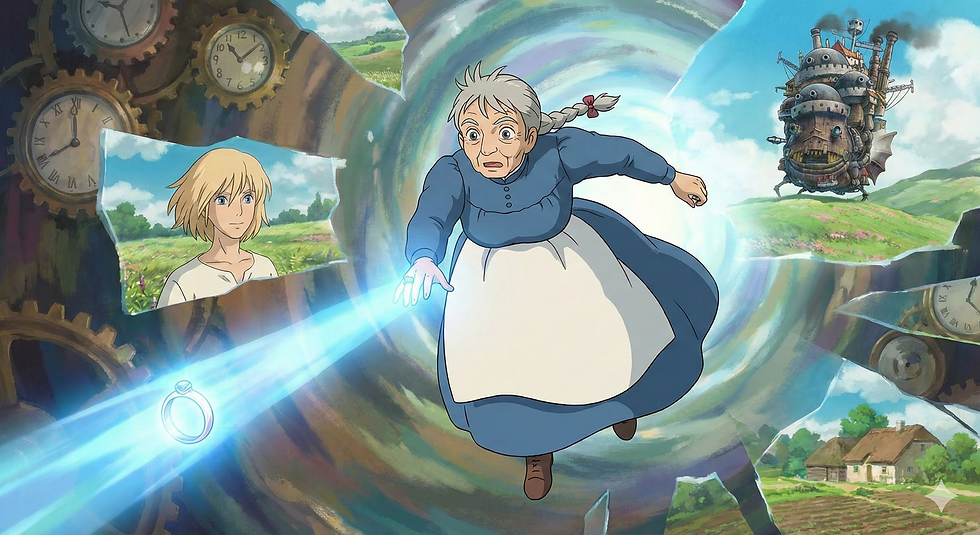
In the film's most haunting sequence, Sophie follows a magic ring that Howl gave her—a ring charmed to lead her back to him. But instead of finding present-day Howl, she's pulled back in time.
She witnesses the moment everything began.
Young Howl, still a boy, stands in a field at night. A star falls from the sky—Calcifer, in his original form, a dying celestial being. Howl catches the falling star and, in an act of compassion and arrogance, gives it his heart. The star transforms into Calcifer. The boy transforms into a wizard. The contract is sealed.

source: AI generated
Sophie sees it all: the original decision, made hastily, with good intentions, that created a system nobody fully understood. A system that worked beautifully and was slowly destroying both parties.
This is data lineage.
When you trace a data quality problem back far enough, you always find the original decision: the schema designed under deadline pressure, the integration built as a "temporary" solution twelve years ago, the field that meant one thing in 2008 and something entirely different now but was never documented.
The Solution—Data Governance Frameworks: Understanding the source requires structured governance. The common thread: define ownership, establish policies, track lineage, and measure quality continuously.
Sophie can't change what young Howl did. But she can see it now. She understands the system.
"Find me in the future!" she calls out to young Howl and Calcifer. She doesn't try to prevent the contract, she just asks them to remember her when the time comes. She's not rewriting history. She's establishing a relationship that spans the system's entire lifecycle.
Breaking the Curse

Sophie returns to the present. She finds Howl, barely alive, more bird than man. The castle is broken. Calcifer flickers weakly—the water didn't quite kill him, but he's fading.
The Witch of the Waste, still holding Howl's heart, finally lets go.
Sophie takes the heart—fragile, glowing, impossibly precious and places it back in Howl's chest.
The effect is immediate. Howl transforms back into himself. Calcifer, freed from the contract, realizes he doesn't have to leave—he chooses to stay. The castle rebuilds itself, better than before, now sustained by genuine partnership rather than binding obligation.
And Sophie? Her curse breaks. Her hair remains silver—a mark of what she's been through—but she's herself again. Young. Strong. Changed.
The lesson is not subtle:
You cannot sustain powerful magic on a flawed foundation. The heart has to be in the right place - literally. The contract has to be understood and renegotiated. The system needs to be cleaned, comprehended, and cared for by someone willing to do the unglamorous work.
The Solution — Modern Data Cleansing Tools: Sophie didn't clean the castle alone, she used what she found. Modern organizations have powerful tools: • OpenRefine — Free, powerful tool for cleaning messy data (OpenRefine.org) • Trifacta / Google Cloud Dataprep — ML-powered cleansing (Flatirons Guide) • Talend — Enterprise-grade data quality (DataHen Overview) • Monte Carlo — Data observability platform (Best Practices) • Informatica / Acceldata — Comprehensive governance solutions (Implementation Guide)
The New Castle

The film ends with an image of hope.
This castle is different. It's not held together by a binding contract and suppressed power. It's sustained by choice, by understanding, by relationships that were earned through crisis and care.

The old castle lumbered across the Wastes. The new one drifts through open sky.
This is what AI-ready data infrastructure looks like.
The Payoff of Getting It Right: Organizations with mature data governance are significantly more likely to move AI from pilot to production. According to Integrate.io research, top AI leaders achieve 10.3× ROI through advanced data integration. Companies implementing DataOps report 60% faster analytics delivery and 45% fewer data quality incidents. The magic isn't just possible—it's sustainable.
Not every organization might get there. Some might stay in their hat shops, convinced that change is too risky. Some might be cursed by disruption and never leave the wilderness. Some might find a powerful castle and never bother to clean it, wondering why the magic never works quite right.
But some—the ones who do the work—will build something that soars.
The Fire Demon Is Waiting
Your organization has a Calcifer.
Maybe it's the AI initiative everyone's excited about. Maybe it's the data lake that was supposed to solve everything. Maybe it's the analytics platform that works brilliantly in demos and mysteriously fails in production.
That fire demon is powerful. It's capable of magic you can barely imagine. And it's waiting for you to give it what it needs.
Not just fuel, because anyone can throw logs on a fire. It needs clean fuel. Consistent fuel. Fuel that someone has sorted, verified, and prepared with care.
It needs a Sophie.
Your organization probably has people like her. They're the data stewards who know where the bodies are buried. The analysts who spend their weekends documenting the pipeline nobody else understands. The engineers who raise concerns about data quality and get told "we'll clean it up later."
They're not always the most celebrated team members. Cleaning isn't glamorous. Documentation isn't exciting.
But when you're ready to let your AI reach its full potential, when you want your castle to fly instead of walk, they're the ones who will make it possible.
────────────────────────────────────────
"The fire demon is waiting. What will you feed him?"
────────────────────────────────────────
If you haven't seen Howl's Moving Castle...
Watch it. Not just for its stunning animation and emotional depth, but for how it shows that the most powerful magic rests on foundations someone had to understand and care for.


Comments